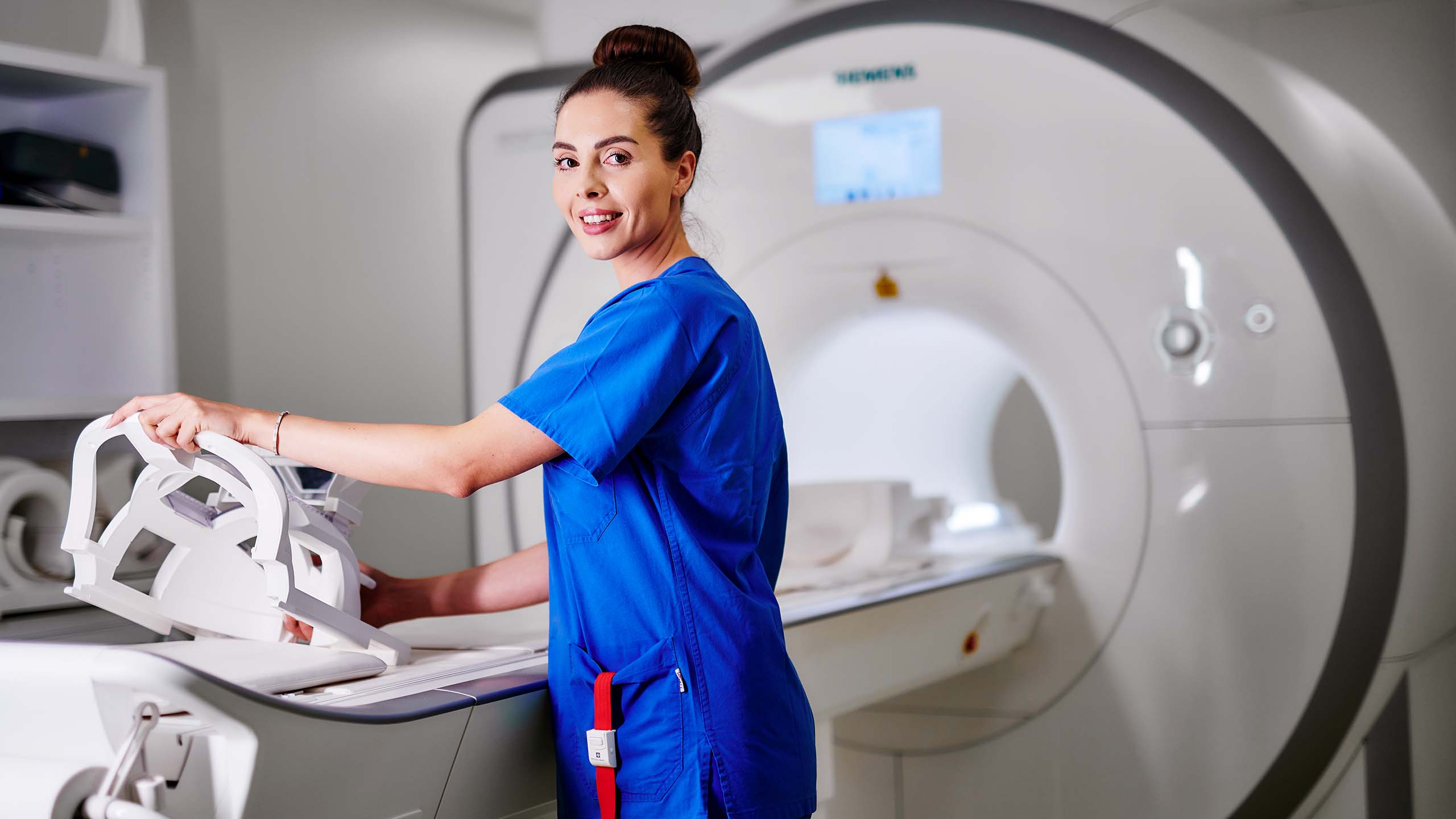

Consistent Dose Reduction through Modern Technology
Thanks to the latest CT technology and intelligent control systems, radiation exposure can be significantly reduced without compromising diagnostic quality.
- Automatic dose modulation tailored to the individual patient
- Optimized scan protocols for each clinical indication
- Continuous advancements in CT technology enabling further dose reduction
Collaboration with Medical Physics Experts (MPE)
The quality and safety of our CT examinations are ensured through close collaboration with certified medical physics experts.
- Regular review and optimization of all imaging protocols
- Alignment with current regulations and diagnostic reference levels
- Ongoing quality assurance and technical monitoring
This interdisciplinary approach is a key component of modern radiation protection.
Established Dose Monitoring and Management System
We use a structured dose monitoring system to continuously analyze and evaluate all CT examinations.
- Automated recording and analysis of patient radiation dose
- Benchmarking against diagnostic reference levels
- Identification and optimization of imaging protocols
Such systems are essential for maintaining transparency and continuously improving radiation safety.
Advantages of CT Imaging
CT offers significant advantages in modern medical imaging and is often the modality of choice in many clinical scenarios:
- Rapid availability and short scan times – particularly important in emergency settings
- High-resolution visualization of bones, organs, and blood vessels
- Excellent suitability for whole-body imaging (e.g., trauma or oncologic staging)
- Reliable detection of bleeding, fractures, and internal injuries
- Accurate planning and follow-up of a wide range of diseases
Especially in acute and emergency diagnostics as well as in whole-body oncologic imaging, CT is indispensable due to its speed and diagnostic accuracy.
Safety and Quality for Our Patients
The combination of advanced technology, structured dose management, and medical physics expertise ensures:
- Minimized radiation exposure with consistently high image quality
- High diagnostic confidence, even at reduced dose levels
- Transparent and reliable quality assurance
Our Commitment
We combine state-of-the-art CT technology with rigorous radiation protection and structured quality management—delivering safe, efficient, and patient-centered diagnostics at the highest level.
Special CT examinations.
In addition to CT examinations of all body regions, we offer you the following special CT examinations:
- Coronary Computed Tomography Angiography (CCTA)
Coronary computed tomography angiography (CCTA) is a heart imaging test to help determine if plaque buildup has reduced the lumen of the coronary arteries, the blood vessels that supply the heart. Unlike traditional coronary angiograms, CT angiograms don’t use a catheter threaded through your blood vessels to your heart. Patients undergoing a CCTA scan receive contrast material as an intravenous injection to depict the lumen of the coronary arteries and help guide further management to minimize the risk of heart attack. The cross-sectional images generated during a CT scan can be reformatted in multiple planes, and can even be used to generate three-dimensional images.